近日,广东工业大学环境健康与污染控制研究院、环境科学与工程学院安太成教授团队在中国部分区域人群的全氟和多氟烷基物质(PFAS)内暴露分析方面取得最新研究进展,研究成果以《Characterizing Regional Variation of PFAS Profiles in Human Serum from China by Integrated Target and Nontarget Analysis with Machine Learning》为题发表在Environmental Science & Technology, 2026,60 (34): 23778–23788 (https://doi.org/10.1021/acs.est.6c04503)期刊上。论文的第一作者为博士生林慧康,通讯作者为安太成教授。该研究主要采集中国山西(SX)、广东(GD)、河北(HeB)和湖北(HuB)等四个代表性区域共1088名志愿者的血清样本,创新性整合非靶向与靶向分析和机器学习方法,在系统解析我国普通人群PFAS区域内暴露特征方面取得重要突破。研究首次在人体血清中发现了7种新型PFAS,系统揭示了不同研究区域间PFAS内暴露水平与组成的显著差异,并识别出与地方特色工业活动密切相关的暴露标志物。该成果不仅深化了对中国人群PFAS内暴露区域分异规律的认识,也为实施差异化健康风险评估和精准污染源头管控提供一定坚实的科学依据。
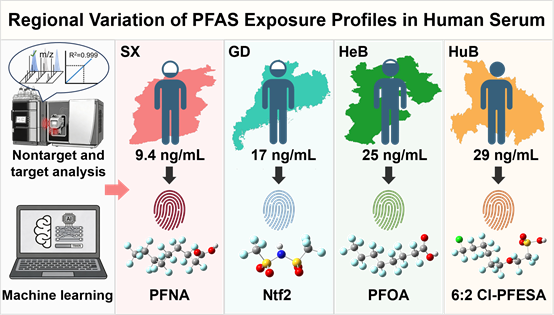
全氟和多氟烷基物质(PFASs)已在全球人群中被检出,但其暴露的区域性差异仍缺乏充分表征。本研究通过靶向分析与非靶向分析结合机器学习方法,基于中国SX、GD、HeB和HuB四个地区共1088份人群血清样本,评估了PFAS内暴露的区域差异。非靶向分析共鉴定出49种PFASs,其中双(三氟甲烷)磺酰亚胺(Ntf2)、C8多氟烷基醚羧酸、C12氢代多氟烷基直链羧酸、8:2氟调聚物不饱和羧酸、1-羟基-6:2氟调聚物磺酸、氟吡甲禾灵和来氟米特首次在人体血清中报道。靶向分析结果显示:SX、GD、HeB和HuB地区人体内的PFAS总浓度分别为9.4、17、25和29 ng/mL,且各类PFAS的组成比例存在区域差异。机器学习分类器在区分四个地区样本时准确率达0.89,表明区域间暴露差异显著。此外,PFNA、Ntf2、PFOA和6:2 Cl-PFESA分别被鉴定为SX、GD、HeB和HuB地区的特征性暴露生物标志物,且各标志物均与当地工业活动密切相关。总体而言,本研究阐明了中国人群PFAS内暴露的区域特异性特征,为因地制宜的健康风险评估和污染控制策略提供一定科学依据。
论文网址: https://doi.org/10.1021/acs.est.6c04503
图文摘要:
英文题目:Characterizing Regional Variation of PFAS Profiles in Human Serum from China by Integrated Target and Nontarget Analysis with Machine Learning
英文摘要:Per- and polyfluoroalkyl substances (PFASs) are globally detected in humans, yet regional variations in PFAS exposure remain insufficiently characterized. Herein, by utilizing target and nontarget analysis with machine learning, differences in PFAS exposure were assessed based on 1088 serum samples of the population from SX, GD, HeB, and HuB regions in China. Nontarget analysis identified 49 PFASs, among which bis(trifluoromethane)sulfonimide (Ntf2), C8 per- and polyfluoroalkyl ether carboxylic acid, C12 hydrogen-substituted polyfluoroalkyl (linear) carboxylic acid, 8:2 fluorotelomer unsaturated carboxylic acid, 1-hydroxy-6:2 fluorotelomer sulfonic acid, haloxyfop, and leflunomide were reported in human serum for the first time. Target analysis indicated total PFAS concentrations of 9.4, 17, 25, and 29 ng/mL in the SX, GD, HeB, and HuB regions, respectively, with compositional profiles differing in the proportions of specific PFAS classes. Machine learning classifiers achieved an accuracy of 0.89 in distinguishing samples from the four regions, revealing significant interregional disparity. Furthermore, PFNA, Ntf2, PFOA, and 6:2 Cl-PFESA were identified as distinctive exposure biomarkers for SX, GD, HeB, and HuB, respectively, each being closely associated with local industrial activities. Overall, this study elucidates the region-specific characteristics of human PFAS exposure in China, providing a scientific basis for regionally tailored health risk assessment and pollution control strategies.
项目资助:本研究受到国家自然科学基金项目(42530702和42407567)、广东省科学技术厅“珠江人才计划”引进创新团队(2023ZT10L102)的联合资助。

