近日,广东工业大学环境健康与污染控制研究院、环境科学与工程学院安太成教授团队在各向异性应变诱导3R-MoS₂压电极化促进甲醛压电光催化氧化机理研究方面取得最新研究进展,研究成果以《Anisotropic Strain-Induced Piezoelectric Polarization in 3R-MoS2 for Enhanced Piezo-Photocatalytic Oxidation of Formaldehyde》为题发表在Advanced Functional Materials (https://doi.org/10.1002/adfm.202528763; 2025; 0:e28763)期刊上。论文的第一作者为赵伟娜副教授,主要作者包括硕士生沈畅和方昕玥,通讯作者为安太成教授。作者首次构建了第一性原理压电极化模型,并结合实验验证,系统揭示了3R-MoS2在原子尺度上对HCHO降解的压电光催化机理。实验表征验证了非中心对称3R-MoS2的合成及其显著的各向异性。这种定向极化策略在催化剂内部建立了内建电场,同时优化了能带结构及关键氧化还原电位,从而实现高效的电荷分离。本研究阐明了应变调控的压电光催化HCHO氧化机制,为发展无贵金属的环境修复技术开辟了新的研究思路。
甲醛(HCHO)作为一种广泛存在且危害性强的空气污染物,其高效去除因传统光催化固有的局限性而仍具挑战性,主要体现在快速电荷复合与不足的活性氧物种(ROS)生成。尽管滑移铁电体3R‑MoS₂的非中心对称结构使其能够借助压电极化克服上述限制,但这种各向异性应变诱导的极化如何调控表面反应动力学的原子尺度起源尚不明确。本文构建了第一性原理压电极化模型,并结合实验验证,系统揭示了3R-MoS₂在甲醛降解过程中原子尺度的压电-光催化机制。我们的研究结果表明:沿扶手椅方向施加的各向异性压缩应变通过不对称的Mo-S键位移诱发强压电极化,而沿之字形方向的应变则几乎无法产生响应。实验表征证实了非中心对称的3R-MoS₂的成功合成及其显著的各向异性特征。所调控的极化场建立了一个内建电场,可同时优化能带结构,并与关键氧化还原电位匹配,从而实现高效的电荷分离。值得注意的是,−6%扶手椅方向的极化使决速步的反应能垒降低了92%,这得益于界面电荷重分布与d带中心的上升。实验进一步验证了3R-MoS₂相较于2H相具有两倍的催化性能提升。本研究阐明了应变引导下的压电-光催化氧化甲醛的机制,为无贵金属参与的环境治理技术开辟了新路径。
论文网址:https://doi.org/10.1002/adfm.202528763
图文摘要:
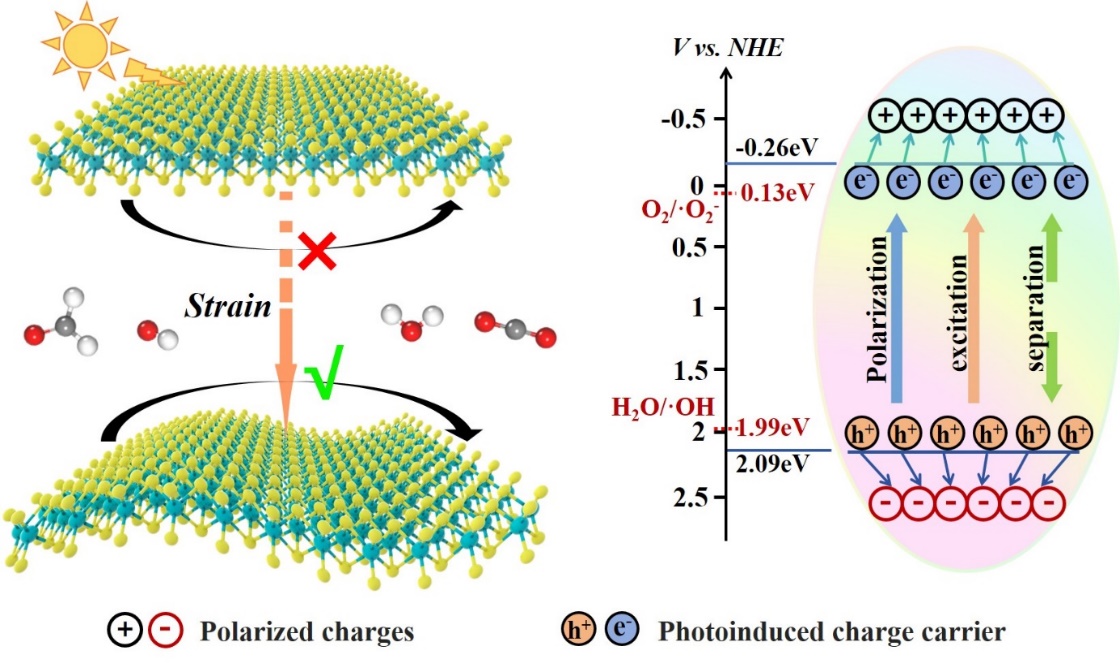
英文摘要: The efficient removal of formaldehyde (HCHO), a pervasive and hazardous atmospheric pollutant, remains challenging due to inherent limitations in conventional photocatalysis, particularly rapid charge recombination and insufficient reactive oxygen species (ROS) generation. Although the non-centrosymmetric structure of sliding ferroelectric 3R-MoS2 enables piezoelectric polarization to overcome these constraints, the atomistic origin of how this anisotropic strain-induced polarization modulates surface reaction kinetics is not well understood. Herein, we develop a first-principles piezoelectric polarization model and integrate it with experimental validation to unravel the atomic-scale piezo-photocatalytic mechanism of 3R-MoS2 for HCHO degradation. Our results demonstrate that anisotropic compressive strain along the armchair direction induces strong piezoelectric polarization via asymmetric Mo-S displacements, while zigzag-oriented strain produces negligible response. Experimental characterization confirms the successful synthesis of the non-centrosymmetric 3R-MoS2 and its pronounced anisotropy. The tailored polarization establishes an internal electric field that simultaneously optimizes band structure and aligns with critical redox potentials for efficient charge separation. Remarkably, -6% armchair polarization reduces the energy barrier of the rate-determining step by 92% through interfacial charge redistribution and d-band center upshift. Experimental validation confirms a twofold catalytic enhancement in 3R-MoS2 over the 2H-phase. This work elucidates strain-directed piezo-photocatalytic HCHO oxidation and paves the way for noble-metal-free environmental remediation.
资助项目:本研究受到国家自然科学基金项目(22576040, 42377221, 42577034)、广东省科学技术厅“珠江人才计划”引进创新团队(2023ZT10L102)的联合资助。

