近日,广东工业大学环境健康与污染控制研究院、环境科学与工程学院安太成教授团队在生物气溶胶健康风险评估研究方面取得重要进展,相关研究成果以“People with respiratory inflammation may be at higher health risk of bioaerosols: A comparative study of air-liquid interface and submerged exposure models”为题,发表于国际期刊Ecotoxicology and Environmental Safety (2026,309,119672)。论文的第一作者为博士生张芸芸,主要作者还包括李桂英教授、梁志梳副教授、王保强教授和博士后罗娜,通讯作者为安太成教授。该研究主要构建了两种体外细胞暴露模型:模拟正常呼吸道上皮的气液界面(ALI)模型,以及模拟病理性气道表面液体(ASL)积聚的新型浸没暴露模型,用于评估铜绿假单胞菌生物气溶胶的细胞毒性。不同暴露模型中生物气溶胶毒性效应的差异强调了暴露微环境在健康风险评估中的重要性。机制分析阐明了呼吸道炎症患者的病原易感性的核心机制,即病理性积聚的ASL通过宿主粘蛋白高分泌与病原体粘附素协同上调,驱动病原体的定植。此外,该研究还可以为开发具有生理相关的先进体外呼吸暴露模型提供一定理论基础。
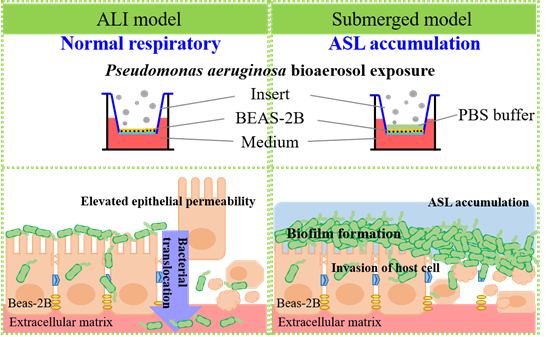
生物气溶胶暴露与多种急性或慢性呼吸道疾病的发生显著相关。然而,其毒理机制尚未完全阐明,暴露模型是一项关键限制因素。尽管ALI模型被广泛认为能较为真实地模拟健康人群的气道微环境的体外暴露模型,在以炎症为特征的各类呼吸道疾病常伴随着ASL异常积聚的症状,在上皮表面形成局部“浸没”的微环境。这种病理状态可能显著改变宿主-病原体互作模式,增加对吸入性病原体的易感性。尽管具有明确临床相关性,目前仍缺乏对病原体在ALI与ASL积聚条件下毒理学效应的系统性比较研究。为此,本研究构建了一种新型浸没式暴露模型,即通过在上皮细胞表面覆盖定量缓冲液层以模拟病理性ASL积聚,并与模拟健康气道微环境的ALI模型对比,系统评估铜绿假单胞菌生物气溶胶的毒理效应。研究发现:ASL积聚微环境显著增强铜绿假单胞菌生物气溶胶的细胞毒性。在浸没式暴露模型中,ASL积聚不仅复制了呼吸道炎症的粘液高分泌特征,还诱导细菌粘附素上调,增强细菌粘附、侵袭与生物膜形成能力,最终导致细胞毒性增强。而在ALI暴露模型中,抑制的连接蛋白修复反应导致旁细胞通透性升高,驱动细菌跨上皮移位。本研究不仅可以阐明呼吸道炎症患者的病原易感性的核心机制,更可以为病理相关的体外呼吸道暴露模型的发展提供了一定模型基础。
网址:https://doi.org/10.1016/j.ecoenv.2026.119672
图文摘要:
英文题目:
People with respiratory inflammation may be at higher health risk of bioaerosols: A comparative study of air-liquid interface and submerged exposure models
英文摘要:
Bioaerosols are ubiquitous presence in ambient air, and inhalation exposure to bioaerosols may be associated with a series of respiratory diseases. However, the cytotoxic mechanism of bioaerosols remains poorly understood, emphasizing need for more physiologically relevant in vitro exposure models that accurately simulate respiratory microenvironment. In susceptible populations with respiratory inflammation, mucus hypersecretion and airway surface liquid (ASL) accumulation are common. Herein, two exposure models were designed: an air-liquid interface (ALI) model simulating normal respiratory epithelium and a novel submerged model simulating inflamed respiratory epithelium with pathological ASL accumulation. Cytotoxicity of Pseudomonas aeruginosa (P. aeruginosa) bioaerosol was explored with the two models. P. aeruginosa bioaerosol exposure (105 and 106 CFU/m3) increased apoptosis by 3.5 % and 8.8 % in submerged model, compared to 0.1 % and 2.4 % in ALI model. In submerged model, ASL accumulation resulted in mucin hypersecretion and upregulation of bacterial adhesins, enhancing P. aeruginosa adhesion, invasion, biofilm formation, and ultimately led to higher cytotoxicity. In ALI model, P. aeruginosa bioaerosol exposure caused greater increases in epithelial permeability despite exhibiting lower cytotoxicity. This disparity resulted from attenuated upregulation of intercellular junction proteins in ALI model (vs. submerged). Our study revealed distinct cytotoxic mechanisms of P. aeruginosa bioaerosols in two models, underscoring the heightened health risks of bioaerosol exposure in individuals with pre-existing respiratory inflammation.
项目资助:
本研究受到国家重点研发计划(2023YFC3708204和2023YFC3708202)、国家自然科学基金(U25A20814和42130611)及广东省珠江人才计划引进创新科研团队项目(2023ZT10L102)的联合资助。

